Leading from the Roots:

Why Soft Skills Are the Soil of Human Learning

  Author
  María Navarro Escribano

  Jovesolides España.

Introduction

“Curricula often emphasize cognitive skills over affective ones, sidelining empathy and socio-emotional learning” (OECD, 2015).
This observation, far from being anecdotal, reveals a structural problem in the way we conceive education and professional development. For decades, we have cultivated technical knowledge and analytical competence while neglecting what sustains all meaningful learning: the emotional and relational roots of human beings.
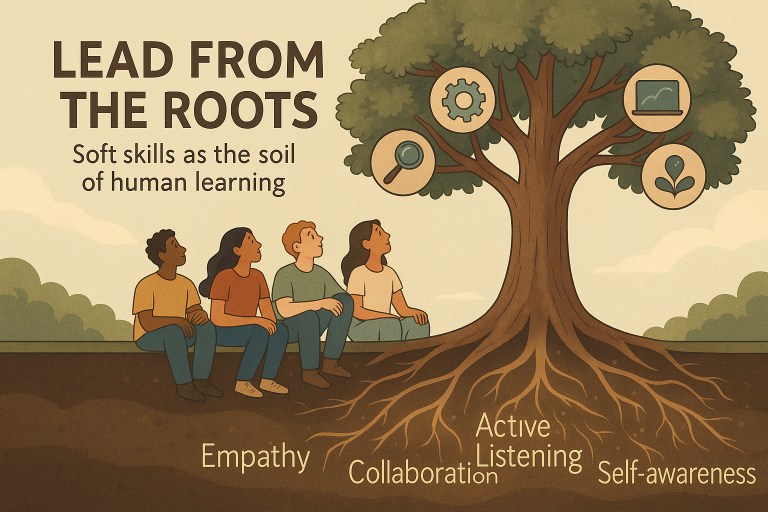
The EmLead project — Leadership through Empathy, co-funded by the Erasmus+ programme, was created precisely to restore this lost balance. Its purpose is simple yet ambitious: to redefine youth leadership through empathy, strengthening the ecosystem of so-called soft skills — active listening, communication, self-awareness, collaboration — as the foundation for sustainable personal and professional development.
In a world changing faster than ever before, it is not enough to “know how to do”; we need to return to “knowing how to be.”
Because, just as in nature, no branch can grow without fertile soil.

The “Nesting” Structure of Skills: An Ecosystem of Learning

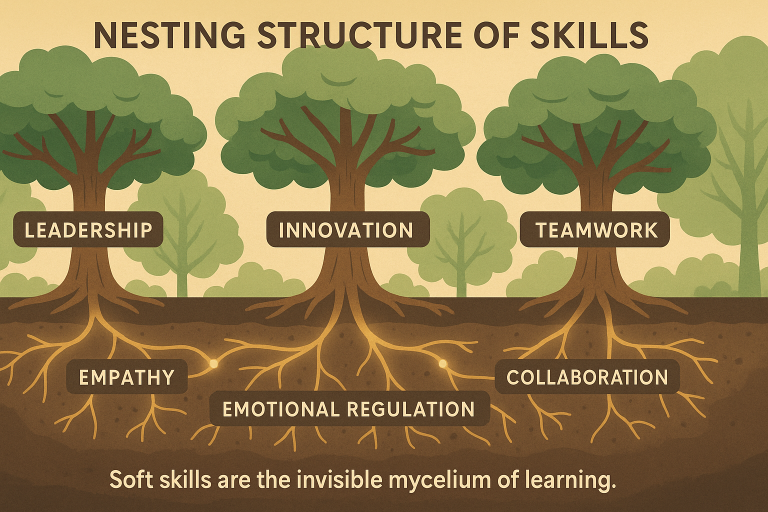
In human and professional development, skills are not isolated compartments: they form an interdependent ecosystem. Learning economists describe this as nesting, a layered structure in which general competencies serve as the trunk supporting more specialised ones. Just as no one can master calculus without first understanding algebra, no professional can lead without first learning how to listen.
We can imagine this process as a living forest of learning. Soft skills — empathy, communication, emotional management — are the invisible roots that nourish the growth of all other competencies. Without them, technical knowledge withers, collaboration fractures, and leadership becomes mere empty authority.
“Like an underground mycelium connecting tree roots,
soft skills are the emotional tissue that holds together the forest of human learning.”


Skill Entrapment: When the Soil Is Barren

The concept of skill entrapment describes an alarming phenomenon: when basic cognitive or socio-emotional skills are not developed in the early stages of life, it becomes extremely difficult to rebuild them later. A person who has not learned to communicate, empathize, or work in a team faces invisible barriers that limit their capacity for adaptation and professional growth.
“Without reading comprehension, without empathy, without the ability to listen, even the best technical training becomes a building on sand.”
Formal education, by prioritizing measurable outcomes and technical competencies, often forgets this biological principle of learning: roots must develop before fruits. And when emotional soil is depleted, productivity and innovation also wither.

Cultivating Fertile Soil: The EmLead Approach

The mission of EmLead is precisely to regenerate that soil. The project proposes an educational transformation grounded in a fundamental principle: empathy can be taught, practiced, and led.
Through a methodology based on role-play, reflection, and direct experience, EmLead creates spaces where young people and youth workers can explore emotions, practice listening, recognize diversity, and learn to guide from understanding. It is not about adding another subject, but about weaving a new way of learning in which emotional skills are the starting point for any other development.
Each participating country contributes its own cultural roots to this shared soil. From this interaction arise materials, training processes, and open resources that will allow the model to be replicated beyond the project.
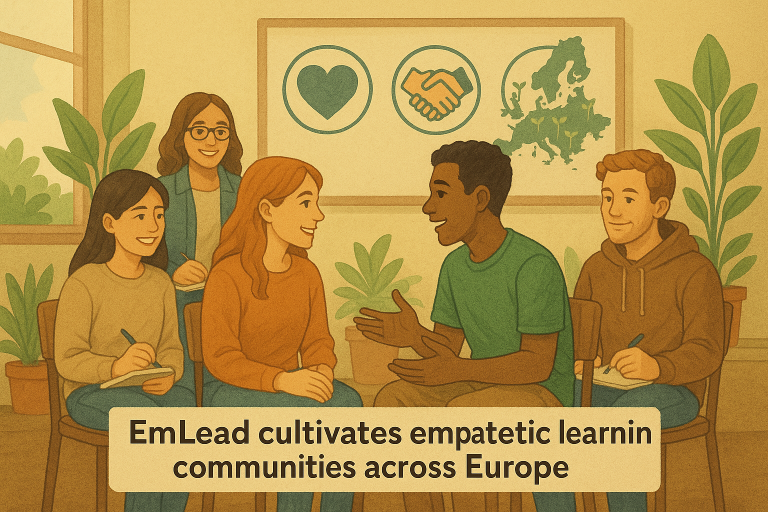
In this way, EmLead cultivates empathetic learning communities that transcend classrooms: living networks where leadership is understood as a relational, not hierarchical, practice.
EmLead cultivates what is not measured in exams: the ability to connect, to care, to understand, and to transform with humanity.”

Conclusion: Toward an Education with Roots

Rethinking education is not only a methodological issue, but an ecological one: it involves restoring balance between the cognitive and the emotional, between performance and relationship, between knowing and feeling. The evidence is clear — without a fertile soil of soft skills, no technical knowledge can be sustained. And without empathy, innovation loses its human meaning.
EmLead is positioned in this context as a practical and urgent response. Its value lies not only in the materials it produces, but in the mindset shift it promotes: understanding that leadership is learned by cultivating empathy, not accumulating power.
Every training module, every role-play activity, every shared reflection space plants in young people the capacity to listen, build trust, and make conscious decisions.
Instead of competing, they learn to connect. Instead of reproducing hierarchical models, they learn to create environments where people grow together.
If we want to build a Europe capable of facing future social and technological challenges, we must begin by caring for its educational soil.
And that soil — made of empathy, communication, cooperation, and community spirit — is precisely what EmLead helps regenerate.
“The leadership of tomorrow will not emerge from machines or algorithms,
but from the human ability to understand and care for the roots that sustain us.”